
I'm Lauren Rath, an Internal Family Systems therapist in Spokane, and I've spent seven years working with those quieter injuries through Internal Family Systems. Richard Schwartz built IFS therapy around a simple idea. Your mind is made of parts, each trying to protect you in its own way, with a steadier Self underneath them.
Most people start looking for a therapist for anxiety in Spokane, WA · IFS Therapy with a directory open in one tab and a fair amount of second-guessing in the other. The listings help, but they won't tell you which results to trust, what the training levels mean, how to check a license, or what to ask before you book.
TL;DR Quick Answers
Therapist for Anxiety in Spokane, WA · IFS Therapy
A good therapist for anxiety in Spokane, WA holds an active Washington license, has IFS Institute training, and treats your anxiety as a protective part working overtime rather than a flaw to fix. IFS therapy helps that part feel understood, so it can loosen its grip.
Check the license: Confirm an active LMHC, LICSW, LMFT or psychologist credential in Washington's Provider Credential Search.
Check the IFS training: Look for Level 1 or higher in the IFS Institute directory.
Use the free consult: Ask how often they treat anxiety and how they pace painful material.
Search statewide: Any Washington-licensed IFS therapist can see you by video while you're in the state.
Expect honesty: A good therapist tells you when CBT or exposure therapy would suit your anxiety better.
Top Takeaways
Check the license before the location. A Spokane tag on a directory listing doesn't guarantee a Washington license.
Treat training levels as a signal. Level 3 and Certified carry weight, while fit still decides more than rank.
Use the free consultation. Ask about training, pacing, anxiety experience, insurance and what happens if it's not a match.
Look statewide. Any Washington-licensed IFS therapist can see you by video while you're in the state.
Count emotional strain as part of recovery. Stress measurably slows physical healing, so the anxious parts of you belong on the care list too.
Where Spokane Residents Actually Find IFS Therapists
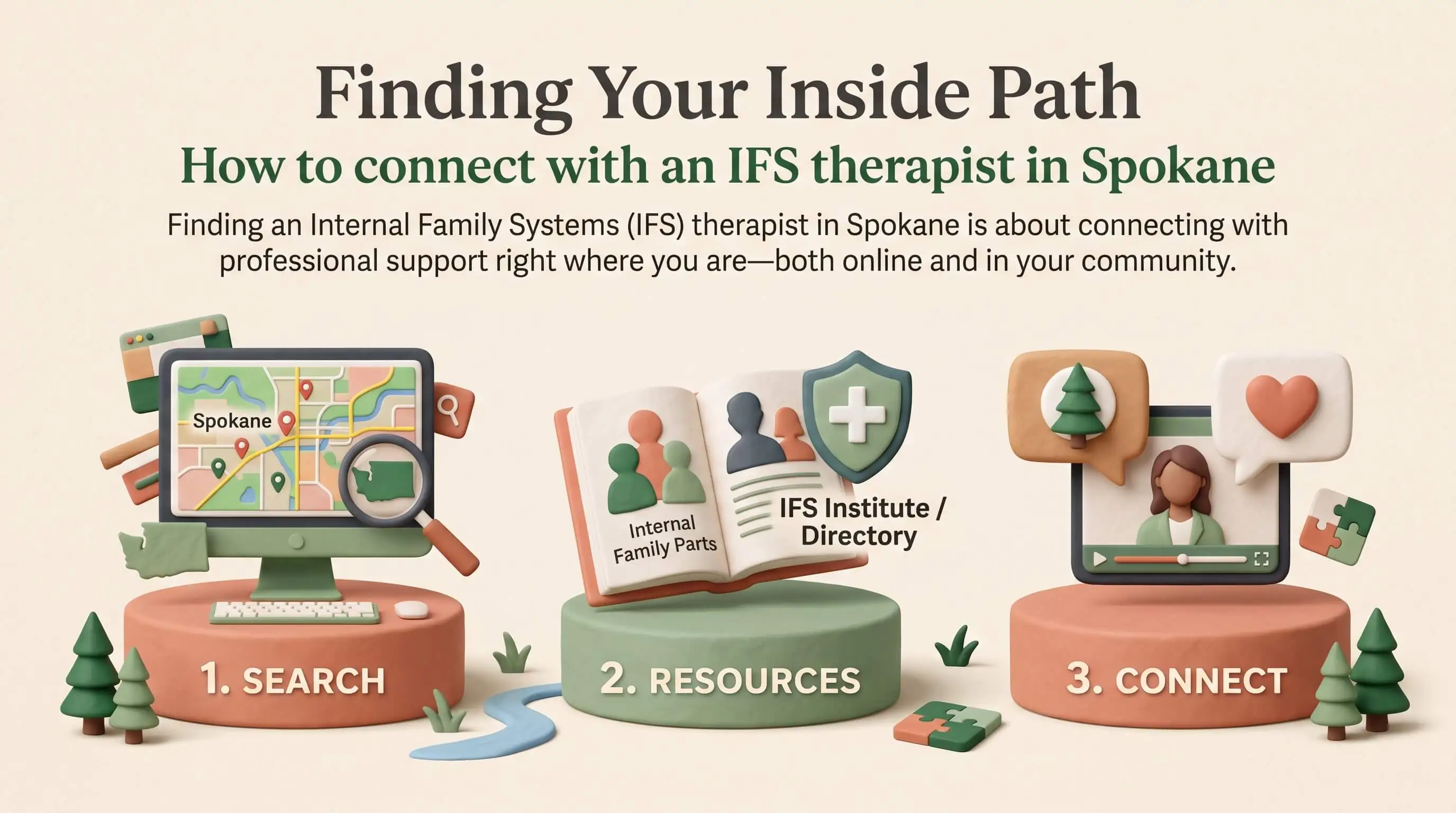
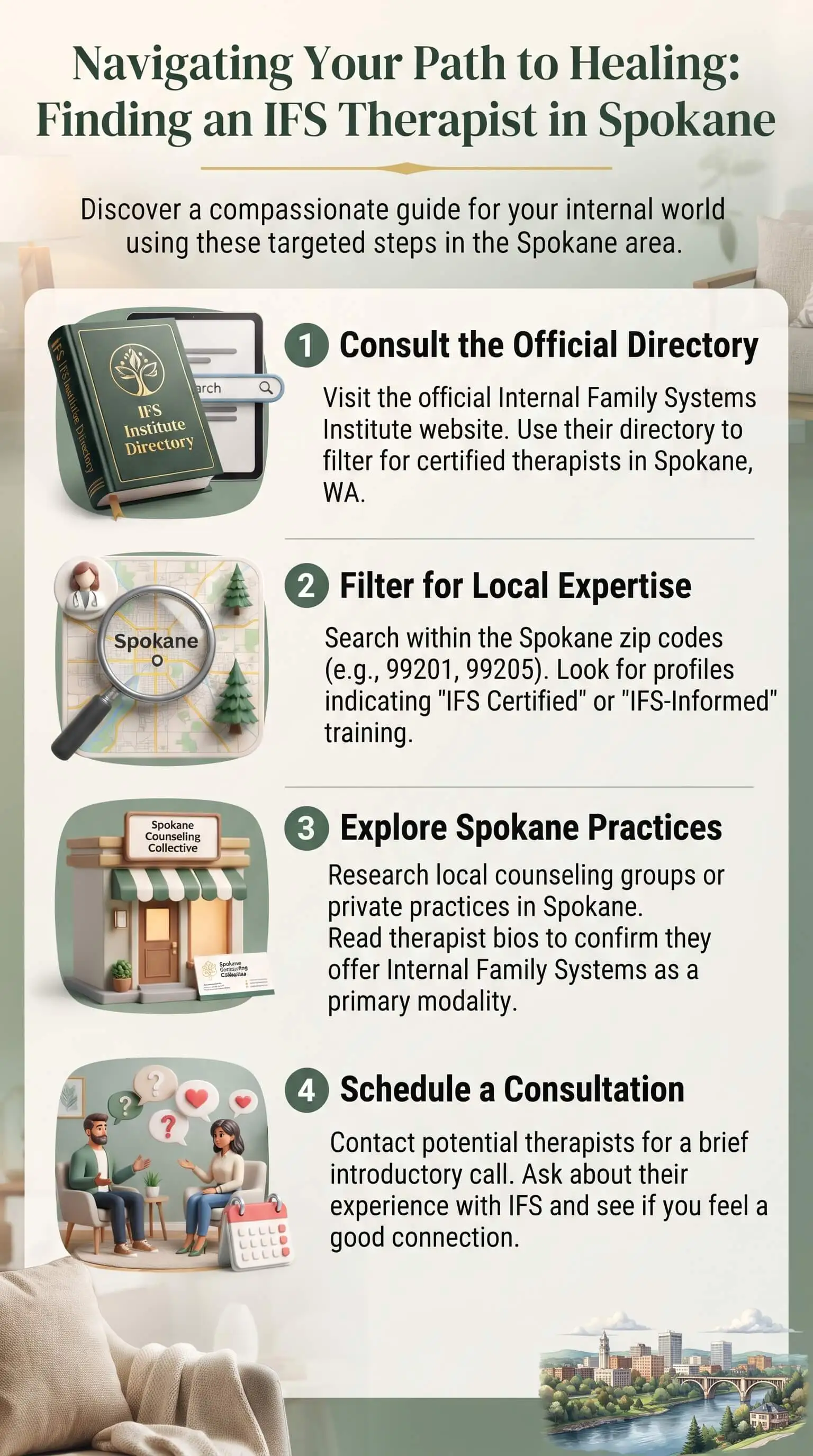
The IFS Institute practitioner directory is the closest thing to an official list, since it only includes clinicians who've completed Institute training. Psychology Today, TherapyDen and Mental Health Match will filter Spokane results by Internal Family Systems too.
Read those Spokane results slowly. Plenty of the names belong to online-only therapists working out of Seattle, Portland or another state entirely, and a few may not hold a Washington license. The IFS Institute says outright that it takes providers at their word about their own credentials.
So sort by Washington licensure before you sort by neighborhood. A therapist on the South Hill and one in Bellingham can both see you legally over video. A therapist licensed only in Idaho can't, even though Coeur d'Alene is closer than Ritzville.
What IFS Training Levels and Certification Mean
Next to most names you'll see Level 1, Level 2 or Level 3, and sometimes the word Certified.
Level 1 is the foundation. Every IFS-trained therapist starts here.
Level 2 adds focused modules, usually on a specific population or a deeper piece of the model.
Level 3 comes after Level 1, at least one Level 2 and an advanced program.
Certified is a separate process where a therapist demonstrates competence through consultation and review.
Training level is worth checking, though no level measures how a person sits with you when something hard surfaces. I've met Level 1 therapists who stay beautifully steady with a frightened part. Given the choice, I'd rather you pick the therapist whose presence settles you than the one with the longest list of training.
How to Check a Washington Therapist's License
Anyone can type "therapist" into a profile. A license is what makes them answerable to the state.
Search the therapist's name in the Washington State Provider Credential Search.
Make sure the credential shows as active. You'll most often see LMHC for a licensed mental health counselor, LICSW for a clinical social worker, LMFT for a marriage and family therapist, or a psychologist license. An A on the end, as in LMFTA, means an associate working under supervision.
Look over the disciplinary history. Nearly every record is clean, and confirming it takes about a minute.
Check mine as well. Any therapist worth seeing will expect you to.
Questions to Ask on Your Free Consult
Most IFS therapists around Spokane offer a short free call before the first session. Bring a few questions with you. These are the ones I'm always glad to hear:
How long have you practiced IFS, and what training have you finished?
Is IFS your main approach, or one of several you draw on?
How do you pace things when something painful comes up?
What usually happens in a first session?
How much of your caseload involves anxiety?
Do you offer in-person sessions, telehealth, or both?
Are you in-network with my plan, and if I self-pay, will I get a Good Faith Estimate?
What happens if we figure out we're not a good fit?
Pay attention to your body during the call as well. Some people hang up with their shoulders sitting a little lower than when they dialed. That counts for something.
Is IFS Therapy a Good Fit for Anxiety?
For a lot of people, yes. IFS usually traces anxiety back to a protective part that's been on duty for years, scanning the room and rehearsing every bad outcome because that vigilance once kept you safe.
Rather than trying to quiet that part, we get curious about what it's guarding. Once it feels understood, it tends to loosen its grip without anyone forcing it.
I'd be doing you a disservice if I stopped there, though. For some anxiety disorders, cognitive behavioral therapy and exposure work carry the deepest research base. A good therapist for anxiety in Spokane, WA should say so plainly and refer you elsewhere when another approach suits you better. IFS isn't the only route through anxiety, but for a lot of the anxious adults I see, it's the one that works.
In-Person in Spokane or Online Anywhere in Washington
Your therapist's license covers the state rather than a zip code. You have to be physically in Washington for each session, but you don't have to be in Spokane.
That matters on this side of the Cascades, where IFS-trained therapists are thin on the ground. When nobody nearby has an opening, telehealth puts the whole state within reach. I offer IFS therapy over secure video to adults anywhere in Washington, and I still call Spokane home.
The setup is modest. You'll want a phone or laptop with a camera and somewhere nobody can overhear you. A spare bedroom works fine, and so does a parked car, which more of my clients use than you'd expect.
What IFS Therapy Costs in Spokane
Directory averages put a Spokane-area IFS session just under $200, with the price shifting by training, license type and whether the therapist bills insurance.
If you're paying out of pocket, federal rules entitle you to a written Good Faith Estimate before care begins. If you're using insurance, ask about in-network status on the consult call. I'm in-network with BCBS, Aetna, Regence, Premera and Cigna, and I'm happy to help you sort out what your plan covers before you commit to anything.
"The people who call me from Spokane usually expect me to tell them what's wrong with them. Most have spent years managing an anxious part that never clocks out. In seven years of IFS work, I've watched the first real shift come, again and again, when that part gets thanked instead of corrected. The worry doesn't vanish that day, though it finally stops having to shout."
7 Essential Resources
Bookmark these before your first consult call.
IFS Institute Practitioner Directory. The Institute's own list of clinicians who've finished its training, with each person's level beside their name. Treat it as a starting point and verify what you find there.
How to Use the IFS Practitioner Directory. A short walkthrough from the Institute on searching by city and keyword. Terms like "anxiety" or "sliding scale" narrow the results fast.
Washington State Provider Credential Search. Washington's primary source for license status and disciplinary records, and the one check I'd never skip.
Understanding Psychotherapy and How It Works. The American Psychological Association on choosing a therapist and what a session should and shouldn't include. It runs long, but the list of questions to ask a provider is worth the scroll.
The Impact of Psychological Stress on Wound Healing. Gouin and Kiecolt-Glaser's 2011 review of how stress slows physical repair. If your body seems to heal slower during hard seasons, this paper lays out the likely reasons.
No Surprises Act Rules and Fact Sheets. The federal rules behind your right to a Good Faith Estimate when you pay for care yourself. Skim the estimate guidance and skip the dispute-resolution detail.
What to Expect From the 988 Lifeline. A walkthrough of what happens when you call, text or chat 988, from the greeting to the counselor's first question. Knowing that ahead of time makes reaching out a little less daunting.
3 Statistics
Three numbers I keep coming back to.
Stress slows physical healing. In a 1995 study, small skin wounds took an average of 48.7 days to close in chronically stressed caregivers, compared with 39.3 days in matched controls. That's roughly 24% longer, and one more reason to look at what slows or speeds recovery beyond the dressing itself. (Kiecolt-Glaser et al., The Lancet, 1995)
Anxiety takes real ground. Among U.S. adults with generalized anxiety disorder in a given year, an estimated 32.3% had serious impairment and 44.6% had moderate impairment. More than three in four are losing something to it at work, at home, or with the people they love. (National Institute of Mental Health)
Spokane's IFS therapists are seasoned, and every listed one offers online care. IFS therapists listed for Spokane on TherapyTribe average 16 years of experience and charge around $199 per session, and 100% offer online sessions. Telehealth here is standard practice rather than a fallback. (TherapyTribe)
Final Thoughts and Opinion
Here's an opinion I'll own. The training level on a profile matters less than most guides admit, and what matters more is whether something in you eases, even a little, during that first call.
Check credentials every single time, because they keep you safe. Past that point, picking the most impressive bio is how people end up spending months being polite to a therapist they never warmed to. The relationship does most of the work. IFS gives it a shape I trust.
A few patterns show up often enough that they've stopped surprising me:
The part that worries hardest is usually the one doing the most work on the person's behalf.
Tears nearly always arrive with an apology, and the apology is never needed.
Progress is easy to miss while it's happening. Usually it looks like a slightly longer pause before the old reaction kicks in.
Anyone worried about doing therapy correctly tends to need permission to do it badly first.
A wound closes from the inside out, and the slower kind of healing does too. Just as wound care and management require patience and attention, emotional healing takes time. You don't have to show up repaired or with the right words. You need someone with a Washington license and solid IFS training who can make room for every part of you.
Frequently Asked Questions
Q: What Is IFS Therapy?
A: IFS therapy is a form of talk therapy, developed by Richard Schwartz, that treats the mind as a system of parts. Some parts protect you, others hold onto old pain, and a calmer Self can lead them all. The goal is getting acquainted with those parts rather than getting rid of them.
Q: How Do I Know if a Spokane Therapist Is Really IFS Trained?
A: Cross-check two sources. The IFS Institute directory shows training level, and Washington's Provider Credential Search confirms the license. If they don't match, bring it up on the consult call. A well-trained therapist will answer without getting defensive.
Q: What Does IFS Certified Mean?
A: Certification is a separate credential beyond the training levels. A certified therapist has finished at least Level 1 and gone through a formal review of their IFS skills. It's a strong signal, though plenty of skilled IFS therapists never pursue it.
Q: Can IFS Therapy Help With Anxiety?
A: Often, yes. IFS treats anxiety as a protective part working overtime, and that part tends to settle once it feels understood. CBT and exposure-based therapy have stronger research behind them for some anxiety disorders, so a good therapist will talk through which one fits you.
Q: Is Online IFS Therapy as Effective as In Person?
A: In my experience, online IFS works well. Most of the work happens internally, so the room counts for less than people expect, and some clients go further at home than they would in an office. You'll need a device with a camera, somewhere private, and to be physically in Washington for each session.
Q: Does Insurance Cover IFS Therapy in Washington?
A: In most cases. Insurers usually cover therapy from a licensed provider rather than a particular method, so the question that matters is whether your therapist is in-network with your plan. Self-pay clients are entitled to a written Good Faith Estimate before care starts.
Q: How Long Does IFS Therapy Take?
A: There's no fixed timeline. Some people feel a shift within a couple of months, while deeper trauma work moves slower and shouldn't be hurried. A good therapist checks in with you about pace and progress as you go.
Q: What if I've Never Done Therapy Before?
A: Most people who contact me haven't either, and you can start without reading anything or learning the vocabulary first. An IFS therapist explains things in plain language along the way and lets you set the speed.
Call to Action
Picking up the phone is harder than it looks, and if part of you is already arguing against it, that's normal. Check the license, write down your questions, and reach out when you're ready rather than when you feel you should be.
If you live anywhere in Washington and want to find out whether IFS fits, book a free 15-minute call. You don't need a plan for what to say.
This page is not a crisis service. If you're in immediate danger, call or text 988, or dial 911.


