A medical practice without a strong copy is a clinical resume hoping someone reads it. The website might be beautiful. The reviews might be glowing. But if the words on the page don't tell a worried patient why your practice is the one that solves their problem, you're going to keep losing them to the practice down the street that figured out how to write like a human.
That gap is what a medical healthcare copywriter closes. The work sits at the meeting point of copywriting and patient psychology, with regulatory awareness as the floor underneath. Medical healthcare copywriting services exist because most clinicians are excellent at care and have no interest in marketing. The two skill sets do not transfer.
TL;DR Quick Answers
medical healthcare copywriting services
Medical healthcare copywriting services produce the patient-facing words that turn clinical authority into booked appointments. The work covers websites, landing pages, emails, paid ads, direct mail, and SEO blog posts for clinics, private practices, and healthcare brands. Every page has to clear three filters general copywriters never deal with: HIPAA, FTC truth-in-advertising rules, and Google's YMYL standards.
This role is separate from medical writing. A medical writer produces clinical content aimed at other practitioners, usually with formal medical training. A healthcare copywriter is a marketing specialist who writes to convert patients.
Top Takeaways
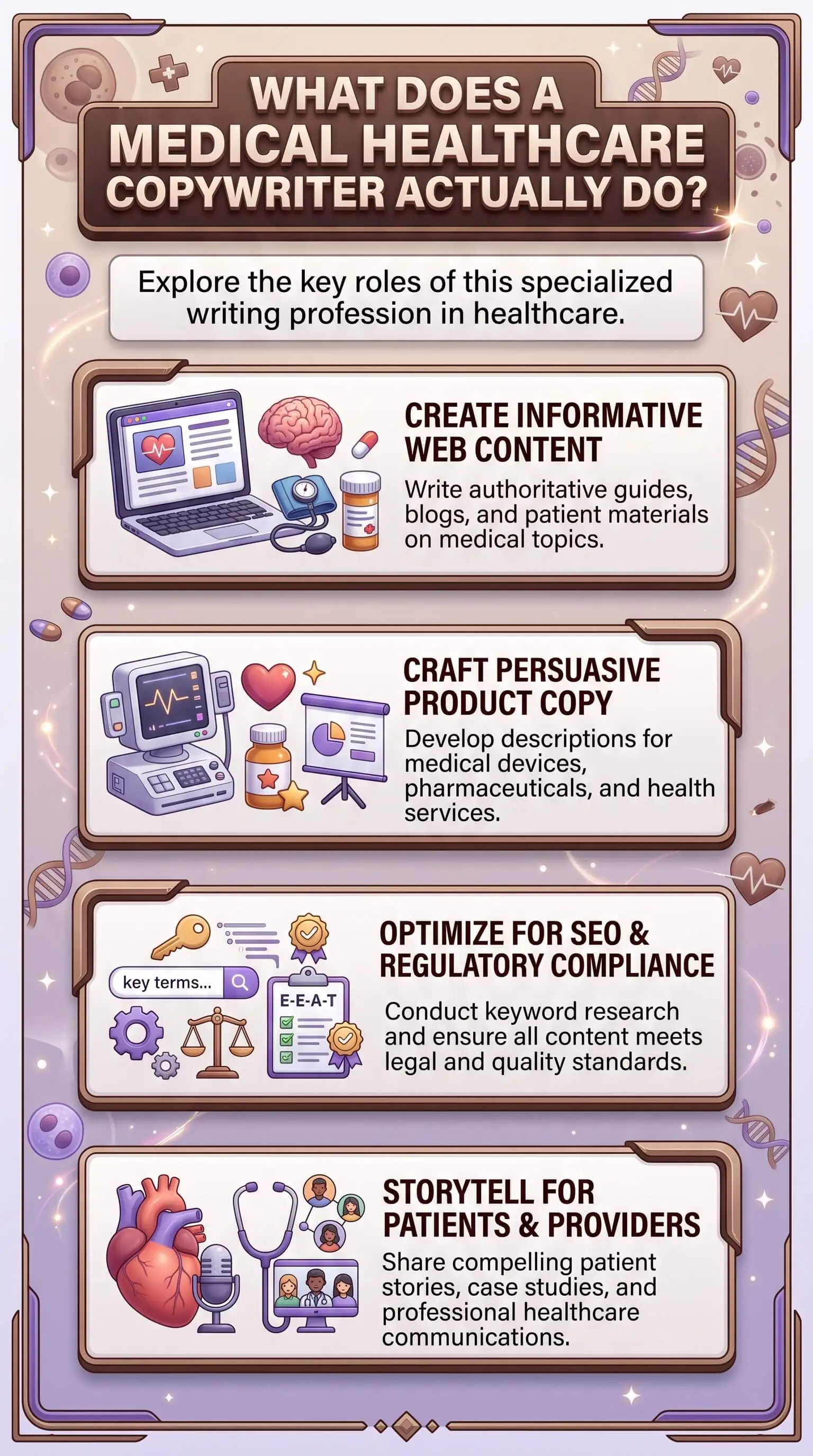
A medical healthcare copywriter writes patient-facing marketing copy that has to be accurate, compliant, and built to convert. Deliverables include websites, landing pages, emails, paid ads, direct mail, and SEO blog posts.
The role is different from medical writing, which produces clinical content for other practitioners and almost always comes from someone with formal medical training.
Healthcare copy runs inside HIPAA, FTC, and YMYL guardrails that most general copywriters have never had to think about.
Trust signals (bylines, credentials, named testimonials, citations) are the structural core of any healthcare page that converts, not decoration added at the end.
The clearest signal it's time to hire one is a plateau in patient inquiries combined with a website that's clearly out of date.
What a Medical Healthcare Copywriter Does Day-to-Day
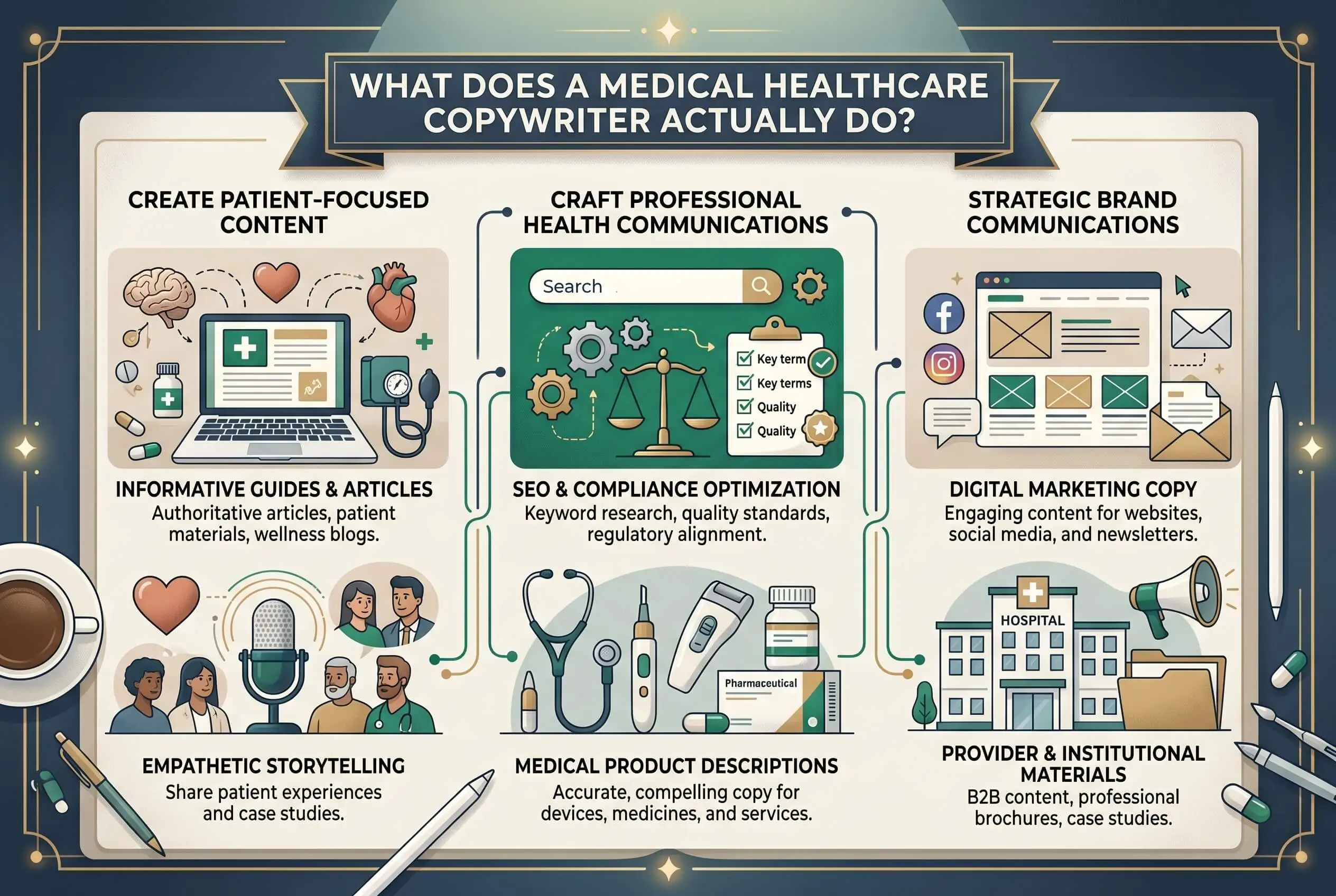
The deliverables change project to project. The categories stay constant. Most of my work involves writing websites, landing pages, patient emails, paid ads, direct mail, intake material, and SEO blog posts. Every piece is built around one job. Get a reader closer to becoming, or staying, a patient.
Research is where everything starts. Before I write a single sentence, I sit down with the practitioner and learn what they treat, how they actually treat it, who their best patients tend to be, and what makes their approach different from the practice four blocks down. Then I research the patient. Their condition, their fears, the words they use when they describe what's wrong, the urgency they're feeling, and the decision they're trying to make. Skip that part and the copy reads like a brochure someone wrote without ever meeting a real patient.
After research, the writing starts. I draft, then run a brand voice pass, then tighten the whole piece for scannability — usually three or four rounds before anything is ready to go live. Most freelancers skip past that work. That's why my copy still holds up six months after launch and theirs doesn't.
How Medical Copywriting Differs From Medical Writing
This is the most common confusion in healthcare marketing, and it costs practices money every year.
A medical writer produces peer-facing clinical content. Think research papers, regulatory submissions, CME modules, drug labeling, and white papers. The audience is other clinicians. Accuracy is the entire game. Persuasion isn't part of the brief. Most medical writers come from medicine or science directly and write with that training in hand.
A medical healthcare copywriter is a different role. The work is patient-facing marketing. The reader is the general public: worried, distracted, and rarely scientifically literate in the way another doctor is. Accuracy still has to be there, but persuasion is the whole point of the page. Most of us come from marketing and communications backgrounds and partner with clinical experts to keep the facts right.
Both roles matter. Hiring a medical writer to do conversion copy is a slow, expensive mistake. So is hiring a marketing copywriter to draft a regulatory submission.
The Compliance Layer: HIPAA, FTC, and YMYL
Healthcare copy operates inside guardrails general copywriters never think about. HIPAA limits what I can say about identifiable patient stories, even with the patient's written permission. The FTC requires you to back every health claim (efficacy, outcomes, comparative results) with competent and reliable scientific evidence. State medical boards add their own rules on top of all that, especially around testimonials and before-and-after representations in elective specialties.
Google adds another layer. Healthcare content sits inside the Your Money or Your Life category, which means search rankings hinge on demonstrated expertise, experience, authoritativeness, and trustworthiness. A copywriter who doesn't know what HIPAA marketing guidance actually says, or what an unsubstantiated efficacy claim looks like to a regulator, can quietly expose a practice to risk it never agreed to take on.
This is why a general copywriter is a bad fit for healthcare. The compliance instincts have to be present from the first draft, not bolted on during legal review.
Trust Signals That Convert
Healthcare websites usually fail for a single reason: the trust layer is missing or buried. People making a medical decision want to know who they're actually trusting with their body, and most healthcare copy never gives them that cleanly.
Here's what actually builds trust on a healthcare page. Author bylines on every blog post. Clinician bios that include real credentials, training, and years in practice. Named testimonials with first names and dates, not generic 'Patient A' quotes. Citations to authoritative sources whenever a claim needs backing. Transparent pricing where the specialty allows it. A real explanation of what happens at a first visit.
Generic mission statements don't build trust. Neither do stock photos of strangers in scrubs, or any phrase that promises an outcome nobody can guarantee. Bios that just call someone 'compassionate' don't either — patients want to know where the practitioner trained and what they've actually treated.
A good copywriter builds these signals into the structure of every page from the start. They're load-bearing, not decoration.
When a Healthcare Practice Should Hire One
Most practices come to me at the same moment. Inquiries plateau or drop. A new competitor opens nearby and starts pulling market share. The website is five years old and reads like it. Or a practitioner is launching a new service line and the current site can't carry it.
If any of those match where you are right now, it's worth looking into specialized medical healthcare copywriting services. The right partner doesn't just give you better paragraphs. They give you a clearer brand voice, a tighter patient journey, and SEO content that earns traffic instead of buying it.
The wrong partner gives you a generic copy you could find on any clinic site in the country. Before you sign anything, ask for healthcare-specific samples and find out how they handle compliance review. Ask what they do when a clinical claim needs sourcing. If the answers are vague, walk.
“The healthcare practices that win online aren't winning because they spend more on marketing. They win because their copy makes a worried patient feel like the practitioner already understands them. Most clinics never pull this lever — and it's the single biggest conversion driver in healthcare marketing. I've watched a one-page rewrite double a practice's intake calls in three months with no other changes.”
7 Essential Resources
HHS HIPAA marketing guidance. The official rules on when patient information can appear in marketing material. Required reading for anyone writing copy for a healthcare brand.
FTC truth-in-advertising standards for health claims. Federal rules covering what health claims you can put in an ad and what evidence you need to back them up.
Google's E-E-A-T quality guidelines. How Google evaluates expertise, experience, authoritativeness, and trustworthiness on YMYL content like healthcare pages.
AMA Guide to Physician Referral Strategies. The American Medical Association's framework for how practices build referral networks. Useful when you're writing for referring providers.
Pew Research Center health information data. Long-running research on how Americans actually search for health information online.
CDC plain language health communication guidelines. Federal guidance on writing health content that's accessible across literacy levels.
National Library of Medicine health literacy research. Peer-reviewed research on how plain-language medical communication affects patient outcomes.
3 Statistics
92% of healthcare seekers read a clinician's bio before booking an appointment, according to a 2024 Healthgrades study. More than half (55%) say what they learn in the bio directly drives the decision to book. (Healthgrades, 2024)
Prominently displaying testimonials and star ratings can lift healthcare website conversion rates by more than 270%. Social proof carries more weight in healthcare than in almost any other category. (DearDoc, 2026)
84% of patients check online reviews before booking care, based on a December 2024 nationwide survey of more than 1,000 U.S. adults. That number is now growing to include AI-generated summaries and voice assistants. (rater8 Patient Choice Report, 2024–2025)
Final Thoughts and Opinion
After years of writing for private practices, multi-specialty clinics, and the agencies that serve them, here's what I've come to believe. The practices that grow steadily are rarely the ones with the best clinical outcomes. They're the ones whose patients actually understand what those outcomes mean — and who can find the practice in the first place when they need help.
That gap between clinical excellence and patient understanding is where copy lives. Closing it is not a marketing nicety. It's how the authority a practice has earned actually reaches the people it's supposed to serve. Most practices treat copywriting as an afterthought, then wonder why their growth flattens. The ones that treat it as a core operating function tend to keep compounding year over year.
Frequently Asked Questions
What is a medical healthcare copywriter?
A medical healthcare copywriter is a marketing specialist who writes patient-facing copy for healthcare brands. The work covers websites, landing pages, emails, ads, and SEO content, and it has to clear the accuracy and compliance bar the industry sets.
How is a medical copywriter different from a medical writer?
A medical copywriter writes persuasive marketing content for patients and the general public. A medical writer produces clinical content for other professionals and almost always has formal scientific training behind them.
What do medical healthcare copywriting services typically include?
Most include website copy, landing pages, SEO blog content, patient-facing email campaigns, direct mail, paid ad copy, and brand messaging strategy. Some providers also handle schema markup and on-page SEO work.
Does a healthcare copywriter need a medical degree?
No. The role demands strong research skills, marketing fluency, and the discipline to fact-check every clinical claim against a credible source. Most successful healthcare copywriters partner closely with practitioners to keep the clinical content accurate.
How much do medical healthcare copywriting services cost?
Rates vary widely. A single landing page might run $500 to $2,500. A full website rewrite for a multi-specialty practice can run $5,000 to $25,000 or more depending on scope and brand maturity.
How long does it take to see results from healthcare copywriting?
New web copy and ad rewrites can shift conversion rates within weeks. SEO content typically takes three to nine months to reach top rankings. Most practices see meaningful intake increases inside one quarter.
Call to Action
If patient inquiries have flattened or your website has aged out of date, it's time to talk to a specialized healthcare copywriter. Clear copy that respects the patient and the regulations is still the cheapest competitive advantage in healthcare marketing, and the easiest one for most practices to get wrong.